|
|
|
|
|
|
|
|
|
|
By Amy Federman, ConantLeadership Editor in Chief & Director of Content
|
|
|
|
|
At ConantLeadership, we're committed to lifelong learning and continuous improvement. In service to your leadership growth, each month we curate this digest of resources to:
- Share actionable advice from top leadership luminaries
- Celebrate a range of viewpoints (inclusion is not an endorsement)
- Contextualize workplace trends through a leadership lens
- Support your personal development in life, leadership, & beyond
|
|
|
|
|
In this edition of the Leadership That Works Newsletter: Pressure is a privilege, a survival guide for chaos, the case for 'reasonableness,' how to measure resilience, clarity beats certainty, & more.
|
|
|
|
|
|
|
From the Golden Anniversary Collection
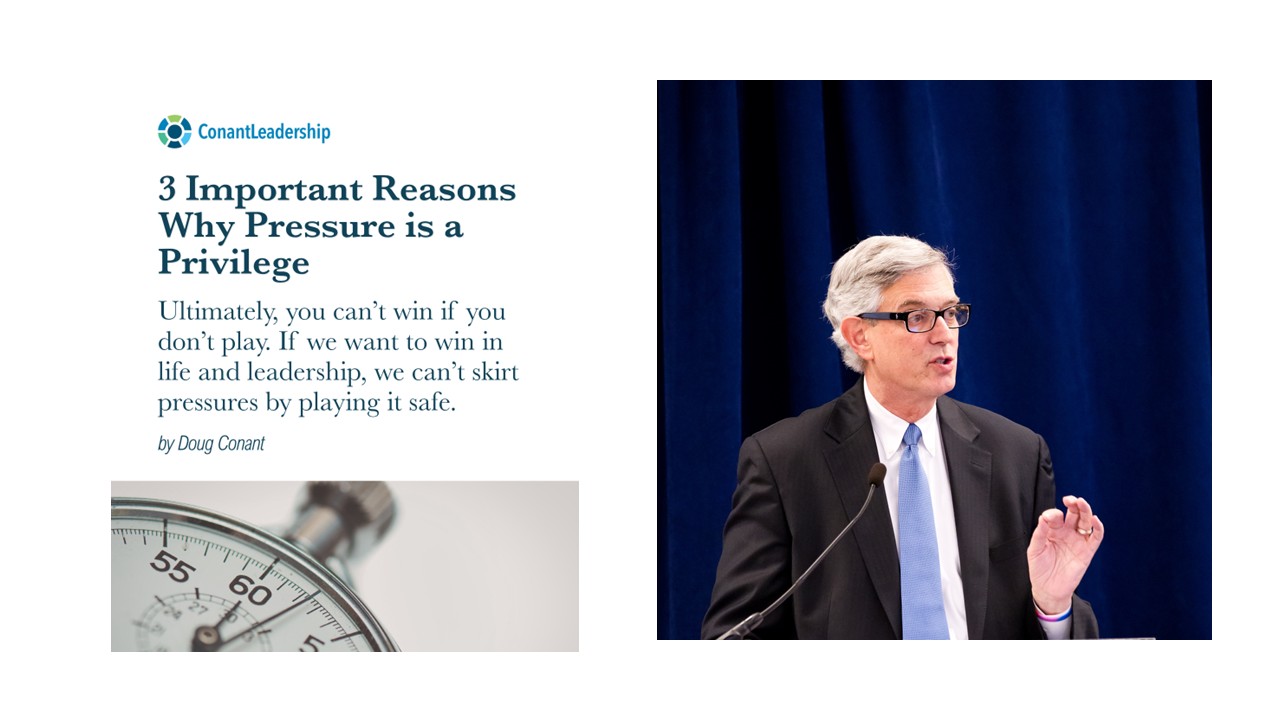
In this latest piece in our “Golden Anniversary” collection—a treasury of Doug’s thought leadership that has been updated to help you meet the current moment as we celebrate his 50 years in leadership—he shares three important reasons why pressure is a privilege. Read an excerpt below or click through to read the full post.
1. Pressure makes us better. Meeting our growth edge from time to time is necessary. You may have heard the aphorism, “Life begins at the edge of your comfort zone.” Pressure naturally pushes us out of that comfort zone and invites us to grow.
We may feel our throats tighten and our nerves heighten when faced with the sudden opportunity to pitch a dream client, or when a new, time-sensitive project falls into our lap. But that sensation of nervous energy can also be harnessed as excitement. What a gift that we can use our unique skills, insights, and convictions to move through a novel situation creatively.
These pressurized conditions also sharpen our skills for the next challenge and improve how we lead in the spaces between. And if we do falter, as all leaders sometimes do, we’ll still be better for it. Get the full story here.
|
|
|
Founder's Corner: What's Doug Enjoying?
A snapshot of resources that our Founder & CEO, Doug Conant, has recently found insightful and/or inspiring.
1. BOOK: What to Make of a Life by Jim Collins
From Doug: "Jim's seminal work, Good to Great, had a profound impact on my personal development; the book challenged me to reframe my thinking about greatness and significantly heighten my own energy, enthusiasm, and curiosity. It was a game changer. In his latest book, What to Make of a Life, he once again challenges the reader to reframe their thinking, this time about life. I highly recommend it."
2. ARTICLE: The Listener by Kate Bennis
From Doug: "Listening is one of the most important leadership skills and I enjoyed this piece from Kate Bennis on the topic. Here's an excerpt: 'What are the skills of Listeners? The biggest challenge is putting away expectation and our own needs, preferences, and judgements. . . . and when thoughts of ourselves, our upcoming appointments, our fixes and judgements arise, we allow them to float on by without ascribing meaning. And bring ourselves back to the other. Again.'"
3. VIDEO: How to Find Your Purpose in 3 Questions by Dan Pink
From Doug: "Enjoy these three thought-provoking questions (that harmonize nicely with our questions in The Blueprint) that help you clarify your purpose. In Dan's words: 'Purpose isn't a lightning strike, it's a pattern of clues you've been leaving yourself your whole life. These 3 questions will help you find them."
|
|
|
A Survival Guide for Chaos
"Minimizing chaos" is "one of the healthiest goals" for any company writes Melissa Swift, CEO of an organizational consulting firm, in this MIT Sloan Management Review article. While obviously desirable, mitigating chaos is much easier said than done. In fact, says Swift, it can feel nearly impossible to leaders whose organizations are navigating "both a chaotic external world . . . and a chaotic internal landscape." But leaders need not descend into despair. There are proven strategies, not only for surviving chaos, but for proactively preparing to "help people handle chaos before things go off the rails." Swift shares four strategies and here are two.
Constantly talk to the teams your team works with. "You don’t have to be a big, messy matrix organization to operate in a teams-of-teams manner. Even relatively small companies feature incredible amounts of interdependency between groups. This phenomenon causes chaos by generating competing priorities." The "healthiest leadership teams," address this issue in an informal but effective way: by getting to "know who their teams are teaming with," and staying "in contact with those teams' leaders."
Explicitly guard against the bad behavior that chaos can conceal. "Academic research explicitly links chaotic environments with every bad workplace behavior," including but not limited to, "bullying by supervisors, conflict between employees and customers, and infighting by employees." This begs the question: Why do we take it for granted that some bad behavior is understandable within the whirlwind of chaos and "accept is as a normal way of working in tough moments"? Swift says leaders should "make it explicit that chaos does not issue everyone a blank check to indulge their worst impulses." Get the full story here.
|
|
|
The Case for Being 'Reasonable'
This StanfordReport coverage of a new book by Krista Lawlor, Being Reasonable: The Case for a Misunderstood Virtue, explains why it's worth the effort to parse the meaning of a highly subjective trait. While every person might have a different definition of what constitutes "reasonable" behavior or expectations, Lawlor argues that "being reasonable is about being able to reliably see what matters in the greater scheme of things." And this attribute is important for leaders because it "helps us to understand other points of view, communicate what we care about, and thoughtfully respond to others." In polarizing times in particular, "reasonableness" can be the secret weapon that enables a team to function collaboratively and acts as a "much-needed tool for productive discussion." Lawlor shares some traits that most offers some tips for strengthening your own reasonableness muscle. Here are the first two.
1. Notice and manage your emotions. "Emotions can help you see what matters to you, but they can also prevent you from seeing what matters to others."
2. Engage with those you disagree with. "Engaging with others helps you understand what matters to you, and why. By listening to critical perspectives, you actually sharpen your reasoning and deepen your understanding of why you value what you do, not just what you reflexively believe."
Get the full story here.
|
|
|
How to Measure Resilience
"Resilience—the ability to cope with adversity and adapt to challenges and change—is a critical business strategy," writes Michele McGovern in this HR Morning piece on how to cultivate a more resilient organization. Championing and building resilience can get murky because it's not as straightforward to define as some other traditional hard skills. Issuing a top-down mandate e.g., "be more resilient" is unlikely to yield results (and will probably cause confusion) but McGovern says there are ways to "influence how resilient" your team becomes, and it's a worthy pursuit because, "when you help employees improve resilience, you build a resilient organization." The first step is getting a baseline measurement of your workforce's resilience. She recommends an assessment tool developed by Dr. Katharina Näswall, which asks employees 11 key questions on a sliding scale. Once you have a good sense of your current resilience levels, you can create a strategy to measure and assess the skill as it grows across five key resilience indicators. Here are two.
Self-efficacy. "That’s employees’ belief in their ability to perform tasks at a certain level.
Train for it: Give front-line managers the tools and time to work with employees to set stretch goals and plan development and coaching to reach them."
Sense of coherence. "This is a belief that what happens will be manageable, comprehensible, and meaningful. Train for it: One way employers can contribute to that is with predictability: in schedules, operations, and the future. Also, be transparent, so employees know what to expect."
Get the full story here.
|
|
|
'Stop running your company, start leading it," says Wharton deputy dean and professor of management Nancy Rothbard in this Wharton@Work coverage of her advice for today's leaders. One of Rothbard's top tips for facing overwhelm in the face of change, is to honor the supreme value of clarity: "In uncertain times, clarity beats certainty," and that should change the way you communicate because, "your team is not just looking for updates. They are looking for meaning. When the environment keeps shifting, people watch how you react to understand what reality is." Rothbard says this fundamentally changes the job of senior leaders. It's no longer about having "all the answers." Now, the imperative is "to provide interpretation, helping the organization make sense of conditions that no one fully controls." It all comes back to your personal agency and how you choose to show up with your team: "You can't stabilize the environment," but you can, "stabilize how decisions get made inside it." Overall, Rothbard reminds leaders, "Your team does not need certainty about the future. They need certainty about how decisions will be made." Get the full story here.
|
|
|
|
|
More from ConantLeadership
|
|
|
Your New Favorite Podcast Is Here
Announcing a new podcast, Two Admins & a Mic, brought to you by ConantLeadership.
What: Honest, practical, insider conversations about leadership, executive support, and the real work behind the administrative profession, from two smart and funny corporate veterans.
Who: Your hosts are Diana Hansen and Melinda Vail Goodnight. They've walked a thousand miles in your shoes. Now they're sharing everything they know. And they're having fun while telling it all.
When: The first episode dropped last week, Wed. 4/22, in honor of Administrative Professionals Day. Listen right here.
Why: "Our mission is to amplify the voices, experiences, and expertise of administrative professionals around the world, highlighting their critical impact on modern organizations." Sign up to get notified when new episodes go live here.
|
|
|
This month we updated one of our most popular quotes roundups of all time with fresh content and new quotes to motivate and inspire you. Click here to get over 40 smart quotes from brilliant people across professions and spheres of influence.
|
|
|
In this conversation, Doug talks with host Marianne Lewis, Dean of University of Cincinnati Carl H. Lindner College of Business, all about how to win in the workplace, the importance of 'abundant' thinking in leadership, and much more.
|
|
|
We're celebrating Doug's Golden Anniversary! Based on his 50 years of leadership experience, Doug is committed to taking the leadership conversation to “Higher Ground” this year. To kick off the "Golden Anniversary" celebration and whet your appetite for more insights, he shared two things every leader needs to think about in the current moment in this blog post.
|
|
|
In last month's newsletter: Two things every leader should know, reading the room is an essential leadership skill, why you need 'cloud' and 'clock' thinking, how to be more magnetic, stop paying the 'speed tax,' and more.
|
|
|
- Amy Federman and the ConantLeadership Team
|
|
|
|
|
|
|
|
|