|
|
|
|
|
|
|
|
|
|
By Amy Federman, ConantLeadership Editor in Chief & Director of Content
|
|
|
|
|
At ConantLeadership, we're committed to lifelong learning and continuous improvement. In service to your leadership growth, each month we curate this digest of resources to:
- Share actionable advice from top leadership luminaries
- Celebrate a range of viewpoints (inclusion is not an endorsement)
- Contextualize workplace trends through a leadership lens
- Support your personal development in life, leadership, & beyond
|
|
|
|
|
In this edition of the Leadership That Works Newsletter: Why leaders should act more like followers, hope is a business strategy, the 'emotional tone' of a team is set at the top, well-being is more important than willpower, and more.
|
|
|
|
|
|
|
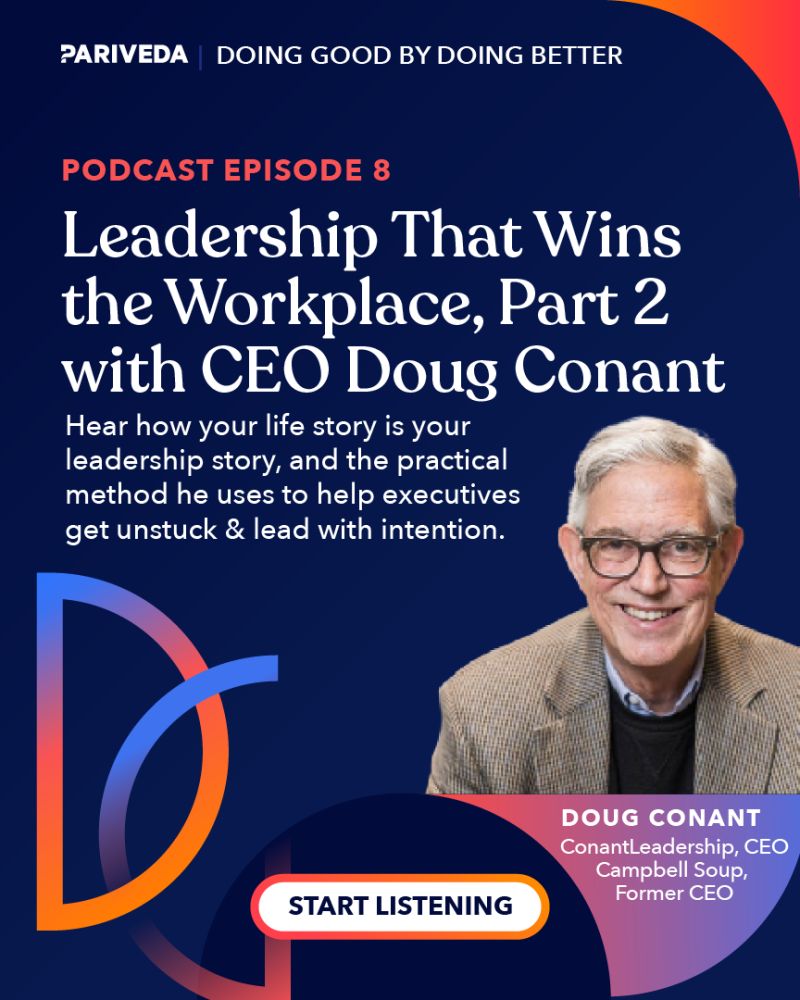
"In this two-part conversation, Doug shares some of the moments that shaped his leadership from the inside out, including getting fired early in his career, a life-altering car accident, and becoming CEO at Campbell Soup and inheriting the worst employee engagement survey results Gallup had ever seen in a Fortune 500 company."
Get tips for looking inward, thriving in the face of adversity, and aligning your life and leadership story from two seasoned leaders who have walked a mile in your leadership shoes.
🎧Listen to Part 1
🎧Listen to Part 2
|
|
|
Founder's Corner: What's Doug Reading & Watching?
A new feature in our newsletter where we highlight resources that our Founder & CEO, Doug Conant, has recently found insightful and/or inspiring.
1. VIDEO: "Idiots vs. Kind, Smart People" from a Commencement Speech by JB Pritzker, Governor of IL
From Doug: "Came across this clip, shared by the Workplace Bullying Institute, from JB Pritzker's 2023 commencement speech at Northwestern University (my alma mater). In just two minutes, he perfectly expresses how empathy and compassion are 'evolved states of being' that require the thoughtfulness and 'mental capacity' to 'step past our most primal urges.' The importance of kindness to workplaces, the world, and to leadership is pressing and urgent in our current moment, which is why this year, as we update our essential tenets of 'Leadership That Works,' we have explicitly added 'Kindness' as a core value."
2. ARTICLE: "Remembering Lou Gerstner: A Giant of Leadership" by Rick Smith
From Doug: "If you've read The Blueprint, you might recall the story of my tough interview at RJR Nabisco with Lou Gerstner in which he challenged me to evidence the courage of my convictions (and I was better for it). Rick Smith captures Lou's spirit admirably in this homage. I never worked for Lou directly but had ample visibility with him when he ran Nabisco for KKR during the 'Barbarians At The Gate' chapter. He was incredibly committed to transforming everything he touched for the better, despite the challenges and the operational complexity required."
|
|
|
To Lead Better, Act Like a Follower
"An underappreciated hallmark of the best leaders today is they have mastered the underrated skills of great followers," write Tomas Chamorro-Premuzic and Amy C. Edmondson, the co-authors of this insightful Harvard Business Review article. Although leadership conversations have partly evolved past a purely hierarchical frame in recent years, the authors note that discussions still "tend toward portraying leadership as a kind of heroic act," which requires a mastery of "the art of command." And the authors say, "most research still treats followers as passive recipients of leadership," when the truth is, "leadership and followership are a co-created, fluid, role-switching process rather than a fixed one-way hierarchy." When leadership is viewed more collaboratively, it reveals that "becoming a better leader is not about asserting authority more skillfully but rather about mastering the capacity to follow well, even from a position of power." The authors offer five "core followership capabilities" that organizations should seek to recruit and develop in their leaders, and here are the first two.
1. Active Listening. "Effective followers listen to understand, not to confirm. They take in information without filtering it through ego, fear, or hierarchy . . . When you truly listen, you reduce blind spots, pick up weak signals earlier, and create psychological safety around you."
2. Prioritize Purpose, Not Personal Credit. "The most valuable followers care more about what works best for the team or organization than who gets the applause . . . Since leadership is fundamentally about persuading others to do things beyond their self-interest, in support of a larger collective, managers should emulate such followers. They should be focused on something bigger than themselves—something that requires others to make it happen."
Get the full story here.
**For more from Amy C. Edmondson, explore our coverage of her conversation with Doug Conant at one of our past BLUEPRINT Leadership Summits.
|
|
|
Hope Is a Business Strategy
"We’ve long misunderstood hope in the workplace. We’ve treated it as wishful thinking—a nice-to-have feeling that emerges when things are going well," but research shows that hope isn't "passive optimism, it’s an active strategy for navigating uncertainty and driving meaningful change" writes Jen Fisher in this excerpt from her new book Hope Is the Strategy. Hope, says Fisher, is not some abstract, fuzzy-wuzzy ideal but rather a powerful "cognitive process with three essential components: goals (what we want to achieve), pathways (our ability to identify routes to those goals), and agency (our belief that we can pursue those paths)." When we think of hope as something to pursue and utilize strategically, we realize that our thinking around it has been backwards: "Hope isn’t what you turn to after strength fails—hope is the strength we’ve been looking for all along. It’s not the light at the end of the tunnel; it’s the torch we need to lead others through it." Fisher continues, "when organizations embed hope into their leadership practices and culture," they can transform attitudes about work and unlock new heights of performance. She says that the key to integrating hope as an essential strategy starts with modeling "sustainable work behaviors and values that will drive purpose and well-being." Fisher provides four examples of these ideal leadership behaviors and here are two.
1. Get Clear on Your Own Boundaries. "If you’re following someone else’s vision of success instead of your own, you’re going to end up miserable and probably burned out. So take that PTO—really . . . a leader who actually sets healthy boundaries and lives by them gives employees permission to do the same."
2. Embrace the Unknown. When we temporarily suspend our need for certainty, a different kind of productivity emerges. I call these my Possibility Days: Once a week, I grant myself permission to coexist with uncertainty. Instead of trying to control outcomes, I deliberately seek experiences with unknown results."
Get the full story here.
|
|
|
Setting the 'Emotional Tone' Is Part of Leadership
"Every organization runs on two systems at once. The formal system is strategy, structure, goals and metrics. The informal system is emotion, trust, confidence and belief," writes Andy Freed in this article in Chief Executive. Freed says that while, "the formal system gets most of the attention," it's actually "the informal system" that drives most of the performance. Generally, a highly functioning informal system hinges on the emotional health of the team doing the work, and the emotional temperature is set at the top. Freed warns: "CEOs often underestimate how quickly their own emotional state spreads. A rushed leader creates rushed thinking. A defensive leader shuts down honest dialogue . . . Tone travels faster than instructions. And as leaders, your tone is always being communicated." The key to regulating the emotional tenor of your unit lies in "emotional discipline," says Freed. This doesn't require forced positivity, "avoiding hard truths," or always being upbeat; "People can handle bad news. What they struggle with is emotional volatility." When leaders act with just a little more intention and "set a consistent emotional tone, alignment improves," showing that "emotional tone is not a soft skill but a performance lever." Get the full story here.
|
|
|
"Where does willpower come from?" asks Jill Suttie, the author of this Greater Good Magazine coverage of a new study that may hold the answer. The conventional thinking around resolutions, says Suttie, is "if only we had more willpower," then we might finally be able to achieve our goals. New research shows the reverse may be true: "Instead of self-control or willpower leading us toward greater well-being in the future, greater well-being increases our ability to have more self-control for meeting our goals." Although it's counterintuitive, the takeaway is that "those of us who wish to change our behavior should focus less on increasing our willpower and more on strengthening our overall well-being." To pursue an approach for self-discipline that is grounded in wellness rather than strictness, Suttie recommends prioritizing "activities that foster positive feelings, a sense of purpose, and social connection," rather than "knuckling our way through." In fact, pursuits that offer more meaning and fulfillment are not "indulgent distractions from the 'real work' of self-control,"—they provide "fertile ground for self-control and discipline to grow." Get the full story here.
|
|
|
|
|
More from ConantLeadership
|
|
|
The STEPS Leadership Course for Administrative Professionals
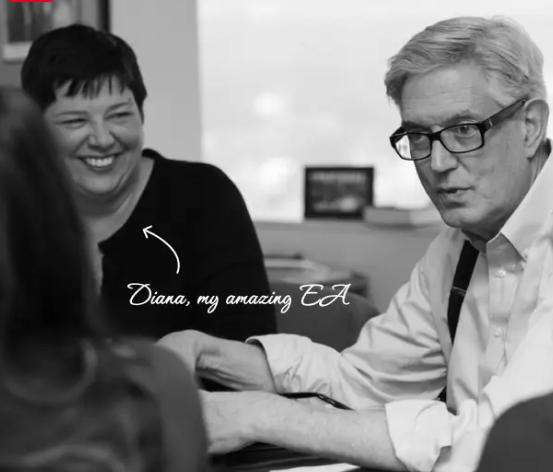
Inspired by Doug’s Executive Assistant, Diana Hansen, and taught by Doug himself, a Fortune 500 CEO, this groundbreaking leadership course teaches the same 6-step BLUEPRINT process we use to train senior executives, customized for the true engine of the C-Suite: Administrative Professionals and Executive Assistants.
This is leadership training powerful enough for the boardroom, but optimized for every room you’re in. No more gatekeeping leadership skills. We’re taking elite-tier leadership training out of the corner office and into your living room, with accessible, self-paced, online programming built for real life.
>>Learn more about the course
>>Use code WELCOME10 for 10% off registration
|
|
|
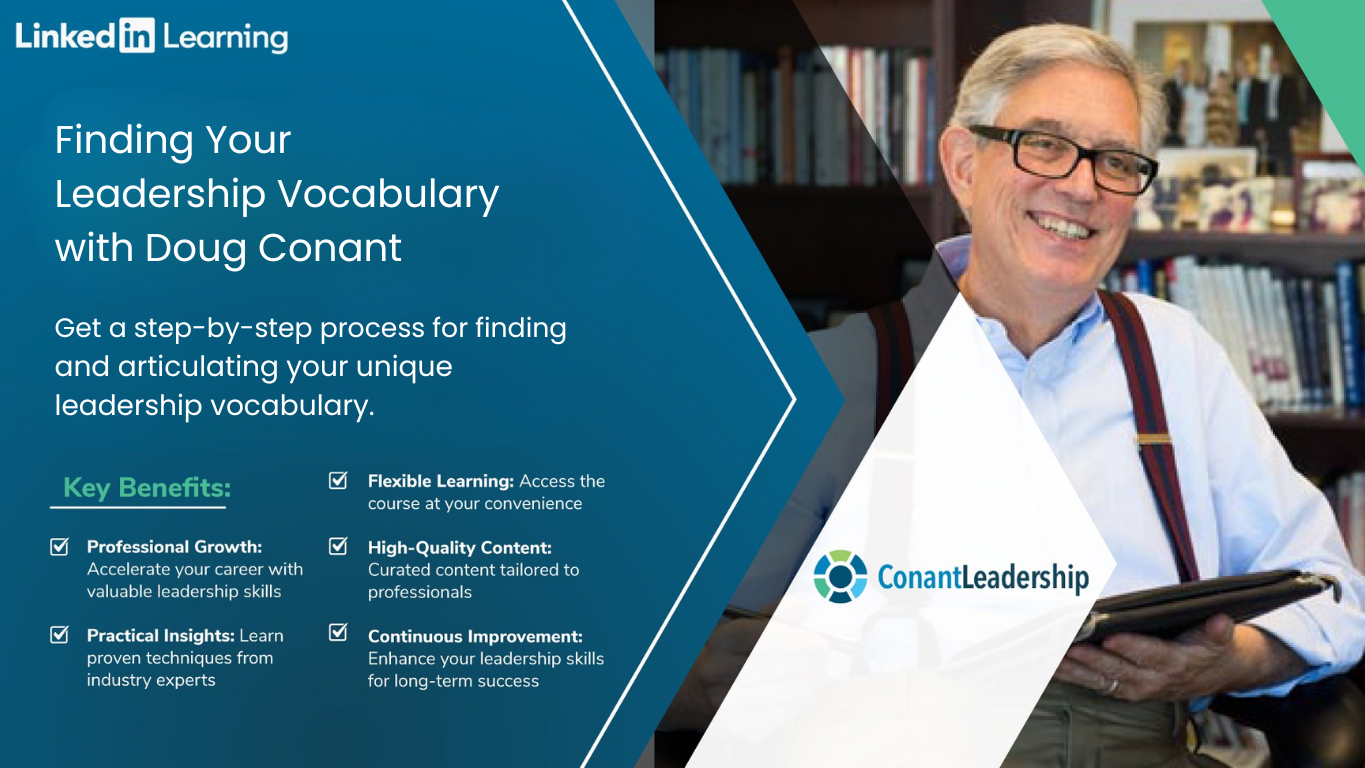
LinkedIn Learning Course: Finding Your Leadership Vocabulary with Doug Conant
In this follow-up to our first LinkedIn Learning course, Finding Your Leadership Purpose with Doug Conant, (which has reached over 88,500 learners), join Doug in this new learning pathway as he guides you through the important work of articulating your leadership beliefs and crystallizing them into a Leadership Vocabulary that you can use to influence others more effectively.
Drawing from years of experience as a top executive and the president and CEO of Campbell Soup Company, Doug teaches you how to lead with authenticity, motivate people, and express your leadership vision with greater impact. Through a series of practical exercises and real-world examples, this course gives you a chance to create your own leadership vocabulary aligned with your core values and beliefs. Check out the new course here.
|
|
|
In this new Forbes coverage of Doug's tenure as CEO of Campbell Soup Company, he talks with Vibhas Ratanjee about how he used a "people first" and purpose-driven strategy to transform the company. Get the full story here.
|
|
|
In this piece from 2019, now newly updated, ConantLeadership Founder & CEO, Doug Conant, reflects on crucible moments from his life and career and reframes them as opportunities for learning and growth, a practice he says is central to having a "gratitude mindset." Get the full story here.
|
|
|
In last month's newsletter: 2025's best leadership lessons to carry you through this new year including how to retain talent for the future, tips for changing your habits, the 3 'E's of good work, 5 crucial conversations for leaders, and more.
|
|
|
- Amy Federman and the ConantLeadership Team
|
|
|
|
|
|
|
|
|